



Table of Contents
Introduction
Filet mignon, the “tenderloin” of beef, is renowned for its melt-in-your-mouth texture and subtle, yet sophisticated flavor . Often reserved for special occasions and upscale steakhouse dinners, this prized cut can be masterfully prepared in your own kitchen
. This comprehensive guide will walk you through every step of creating the perfect oven-baked filet mignon, from selecting the ideal cut and understanding the science of preparation to mastering cooking methods like the reverse sear for a coveted crust and juicy interior
. We will also provide detailed recipes for compound butters, classic pan sauces, and steakhouse side dishes to turn your meal into a truly memorable event
Understanding the Majesty of Filet Mignon
Derived from the smaller end of the tenderloin, the filet mignon is exceptionally tender because the muscle it comes from does very little work . This results in a steak with very little fat or connective tissue, which contributes to its signature buttery texture
. While it may be less intensely beefy in flavor compared to cuts like ribeye or New York strip, its tenderness is unparalleled
. The key to a sublime filet mignon experience lies in a cooking method that honors its delicate nature—a combination of controlled, gentle heat to cook the interior evenly and a final high-heat sear to develop a flavorful crust
Selecting the Perfect Filet Mignon
The journey to an extraordinary filet mignon begins at the butcher counter . Understanding the distinctions in beef grading and feeding methods is crucial for selecting a cut that aligns with your taste and cooking aspirations
USDA Beef Grades: Prime, Choice, and Select
The United States Department of Agriculture (USDA) grades beef based on the age of the cattle and the degree of marbling—the intramuscular fat that appears as fine white flecks within the muscle
. This marbling is key, as it melts during cooking, infusing the meat with flavor and juiciness
- USDA Prime: This is the highest grade available, awarded to only about 2-5% of all beef . It comes from young, well-fed cattle and boasts abundant marbling (8-13% fat) . This high-fat content results in a filet mignon that is exceptionally tender, juicy, and has a rich, buttery flavor . Prime cuts are most often found in high-end restaurants and specialty butcher shops .
- USDA Choice: A step down from Prime, Choice beef still offers high quality and accounts for over half of all consumable beef . It has less marbling than Prime (4-10% fat) but is still tender and flavorful, making it the most widely available grade in grocery stores . A Choice filet offers a great balance of tenderness and value .
- USDA Select: This grade is leaner, with only slight marbling (2-4% fat) . Because it has less fat, it is less juicy and flavorful than Prime or Choice cuts . A Select filet can dry out more easily and may benefit from cooking methods that preserve moisture .
Grass-Fed vs. Grain-Fed: A Matter of Taste
Beyond the USDA grade, the diet of the cattle significantly influences the taste and texture of the beef .
- Grain-Fed Beef: These cattle are typically “finished” on a diet of corn and soy, which promotes extensive marbling . This results in beef with a milder, sweeter, and more buttery flavor profile that many associate with a classic steakhouse experience . The higher fat content also makes it more forgiving to cook .
- Grass-Fed Beef: Raised on a diet of grass and forages, this beef is leaner with a more pronounced, earthy, and mineral-forward “beefy” flavor . Because it is leaner, grass-fed filet mignon cooks approximately 30% faster than its grain-fed counterpart and is more susceptible to overcooking . It’s crucial to cook it to no more than medium-rare to retain moisture .
What to Look For:
- Thickness is Key: Opt for a filet that is at least 1.5 to 2 inches thick . Thicker cuts are more forgiving and easier to cook to the perfect temperature without overcooking the center, especially when using methods like the reverse sear .
- Color: A fresh filet mignon should have a vibrant, deep red color .
- Trimming: Filet mignon is a lean cut and typically requires minimal trimming . If there is any silver skin (a thin, silvery membrane), it’s best to have the butcher remove it, as it can be chewy .
The Science of Preparation: Dry Brining
The way you salt your steak can dramatically impact its final flavor and texture
. While salting just before cooking is common, dry brining is a scientifically superior method for achieving a succulent, deeply seasoned, and incredibly juicy filet mignon
The Detailed Scientific Process
Dry brining relies on the principles of osmosis and diffusion to season the meat from the inside out
- Osmosis: Initially, the salt on the steak’s surface draws moisture from within the meat . This moisture dissolves the salt, creating a highly concentrated brine on the surface .
- Protein Denaturation: This surface brine begins to break down and denature the muscle proteins, particularly myosin .
- Diffusion: Through diffusion, the concentrated, flavorful brine is reabsorbed back into the meat, carrying the salt deep into the muscle fibers . This process alters the protein structure in a way that helps the meat hold onto more of its natural juices during cooking .
- Crust Formation: As the steak rests uncovered in the refrigerator, its surface becomes very dry . This desiccated surface allows for a much faster and more pronounced Maillard reaction—the chemical process responsible for the delicious brown crust—when the steak hits the hot pan .
Dry Brining vs. Salting Just Before Cooking

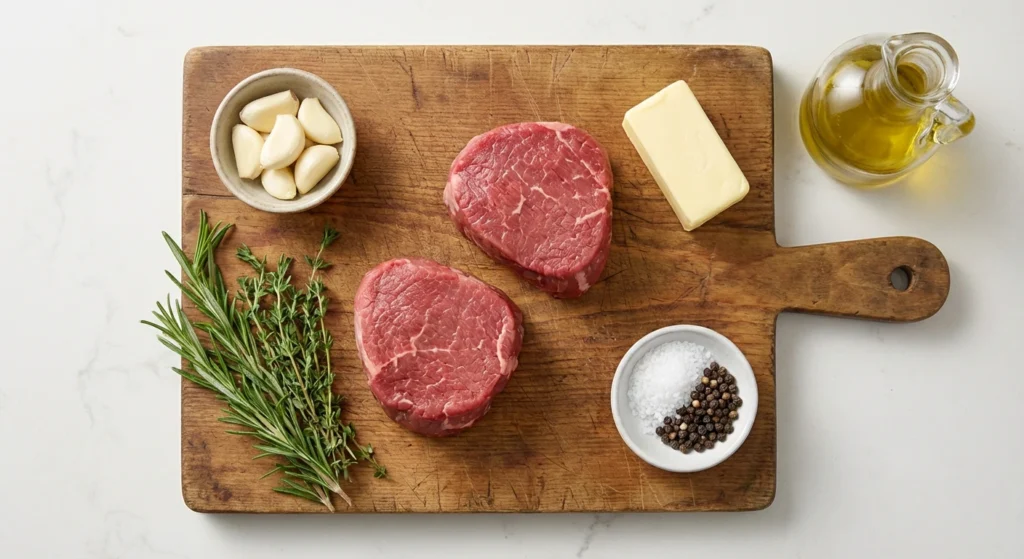
Step-by-Step Guide to Dry Brining
- Pat Dry: Use paper towels to thoroughly dry the entire surface of the filet mignon .
- Season Generously: Use about 1/2 to 1 teaspoon of kosher salt per pound of steak . Evenly coat all sides, including the edges . You can add freshly ground black pepper at this stage as well .
- Elevate and Refrigerate: Place the seasoned steak on a wire rack set inside a baking sheet . This allows for air to circulate on all sides, which is crucial for drying the surface .
- Rest Uncovered: Refrigerate the steak uncovered for at least 1-2 hours . For the best results with a thick cut, you can extend this time to 24, 48, or even up to 72 hours for a more pronounced effect .
- No Rinsing Needed: Do not rinse the salt off before cooking . The salt has been absorbed, and the surface is perfectly prepped for searing .
Essential Tools for Success
To achieve steakhouse-quality results, having the right equipment is crucial .
- Oven-Safe Skillet: A heavy-bottomed, oven-safe skillet is non-negotiable . A cast-iron skillet is the gold standard as it retains and distributes heat exceptionally well, which is essential for a perfect sear .
- Instant-Read Meat Thermometer: This is the most important tool for guaranteeing your steak is cooked to your desired level of doneness . Relying on cooking times alone is inaccurate .
- Wire Rack on a Baking Sheet: Essential for both dry brining and the reverse sear method to ensure even air circulation .
- Tongs: Use tongs to handle the steak to avoid piercing the meat and allowing juices to escape .
A Comparative Guide to Cooking Methods
While this guide focuses on the reverse sear method, understanding other techniques can help you appreciate the science behind a great steak
The Ultimate Reverse Sear Filet Mignon Recipe
The reverse sear method is a culinary game-changer for thick cuts like filet mignon
. It involves cooking the steak low and slow in the oven before finishing it with a high-heat sear, ensuring an incredibly even cook from edge to edge with a minimal gray band
. By starting the steak in a low-temperature oven, you gently and slowly raise its internal temperature, allowing the muscle fibers to cook evenly without the aggressive heat that overcooks the outer layers
Ingredients:
- 2 filet mignon steaks, 1.5 to 2 inches thick (about 8 ounces each)
- Kosher salt and freshly ground black pepper
- 1-2 tablespoons of high-smoke-point oil (like grapeseed, canola, or avocado oil)
- 2 tablespoons of unsalted butter
- 2 sprigs of fresh thyme or rosemary (optional)
Step-by-Step Instructions:
Step 1: Prepare the Steaks
Follow the dry brining guide above for the best results
. If you are short on time, pat the steaks dry and season liberally with salt and pepper
. Let the steaks sit at room temperature for 30-60 minutes before cooking
Step 2: Low and Slow in the Oven
Preheat your oven to a low temperature, between 225°F and 275°F (107°C to 135°C)
. Place the steaks on a wire rack set on a baking sheet
Step 3: Monitor the Temperature
Place the baking sheet in the preheated oven
. Cook until the internal temperature is 10-15°F below your desired final temperature
. For a medium-rare finish (135°F), pull the steaks from the oven when they reach 120-125°F
. This can take 20-45 minutes depending on steak thickness and oven accuracy
. Use an instant-read thermometer for accuracy
Step 4: Rest Before Searing
Remove the steaks from the oven and let them rest on a cutting board for about 10 minutes
Step 5: The Final High-Heat Sear
While the steaks rest, heat a cast-iron skillet over high heat until it is very hot
. Add the high-smoke-point oil
Step 6: Sear for the Crust
Carefully place the steaks in the hot skillet
. Sear for 1-2 minutes per side, until a deep brown crust forms
. Use tongs to sear the edges of the filets as well
. During the last minute, add the butter and herbs
. Tilt the pan and use a spoon to baste the steaks with the foaming butter
Step 7: Serve Immediately
Unlike traditionally cooked steaks, a reverse-seared steak does not need a long rest after searing and can be sliced and served almost immediately
Internal Temperature Guide for Filet Mignon
For the most accurate results, pull the steaks from the oven when they are about 10-15°F below your desired final temperature to account for carryover cooking during the sear
- Rare: Final temp 125°F (pull from oven at 115°F)
- Medium-Rare: Final temp 135°F (pull from oven at 120-125°F)
- Medium: Final temp 145°F (pull from oven at 130°F)
- Medium-Well: Final temp 150°F (pull from oven at 135°F)
- Well-Done: Final temp 160°F (pull from oven at 145°F)
Finishing Touches: Compound Butters & Pan Sauces
A perfectly cooked filet is a masterpiece, but a finishing touch can elevate it further
. Choose between a flavorful compound butter that melts into a sauce or a classic pan sauce made from the steak’s drippings.
Delectable Compound Butters
Compound butters are a simple, elegant way to add a burst of flavor
. To prepare, mix softened butter with your desired ingredients, roll it into a log using parchment paper, and refrigerate for at least an hour to firm up
. They can be refrigerated for up to a week or frozen for several months
1. Classic Garlic and Herb Butter
- Ingredients: 1/2 cup softened unsalted butter, 2-4 minced garlic cloves, 1 tbsp chopped fresh parsley, 1 tbsp chopped fresh chives, 1/2 tsp chopped fresh rosemary, 1/2 tsp chopped fresh thyme, 1/4 tsp salt, 1/4 tsp black pepper .
- Application: A timeless choice that perfectly complements the rich flavor of beef .
2. Savory Blue Cheese and Chive Butter
- Ingredients: 1/2 cup softened unsalted butter, 1/4 cup (2 oz) crumbled blue cheese at room temperature, 2 tbsp chopped fresh chives, 1/4 tsp black pepper, pinch of salt .
- Preparation: Whip the butter until fluffy, then gently fold in the blue cheese, chives, and pepper .
- Application: The tangy notes of blue cheese cut through the richness of the filet .
3. Smoky Paprika and Chili Butter
- Ingredients: 1/2 cup softened unsalted butter, 1 tsp smoked paprika, 1/2 tsp chili powder, 1/4 tsp cayenne pepper or dried chili flakes, 1/2 tsp garlic powder, pinch of salt .
- Application: Adds a warm, smoky, and slightly spicy kick to your steak .
Classic Pan Sauces (No Wine)
After searing your steak, don’t wash the skillet
. The browned bits stuck to the bottom, called fond, are packed with flavor and are the secret to an incredible sauce

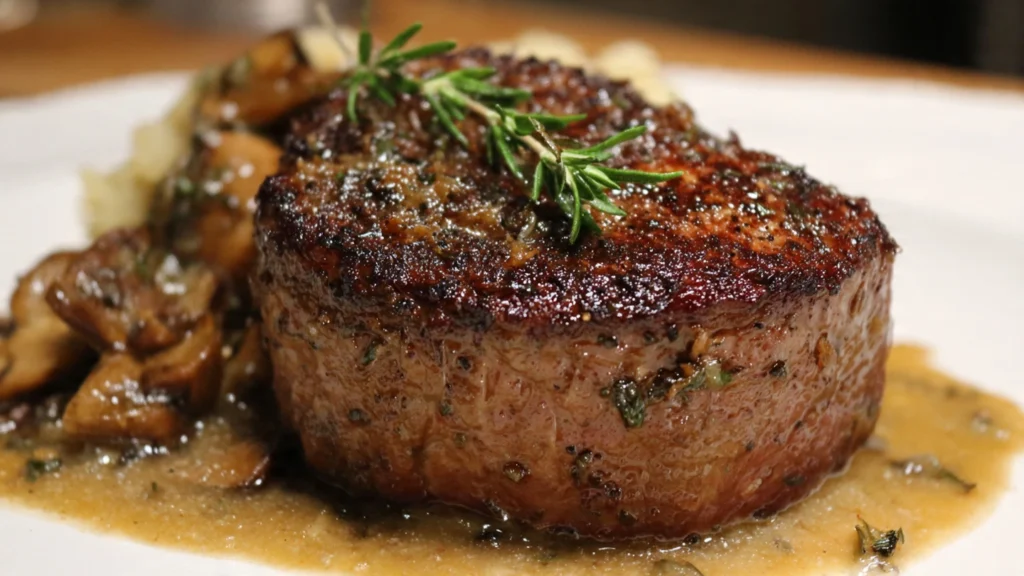
1. Classic Mushroom Cream Pan Sauce
- Ingredients: Pan drippings, 1 tbsp unsalted butter, 1 large chopped shallot, 2 minced garlic cloves, 8 oz sliced cremini mushrooms, 1 cup beef broth, ½ cup heavy cream, 1 tsp fresh thyme, salt, and pepper .
- Instructions: Sauté shallot in the pan drippings and butter until soft . Add garlic, then mushrooms, and cook until well-browned, about 8-10 minutes . Deglaze with beef broth, scraping up the fond . Reduce by half, then lower heat and stir in heavy cream . Simmer until thickened, season, and serve over steak .
2. Tangy Balsamic Glaze Sauce
- Ingredients: Pan drippings, 1 tbsp unsalted butter, 1 small chopped shallot, 1 minced garlic clove, ½ cup balsamic vinegar, ⅓ cup beef broth, 1 tbsp Dijon mustard, 1 tsp honey (optional), 1 sprig rosemary, 1-2 tbsp cold butter pieces .
- Instructions: Sauté shallot and garlic in the pan . Deglaze with balsamic vinegar and beef broth, scraping up the fond . Whisk in mustard and honey, add rosemary, and simmer to reduce until glossy, about 4-5 minutes . Turn off heat, remove rosemary, and whisk in cold butter pieces until emulsified .
Classic Steakhouse Side Dishes
A great steak deserves equally impressive side dishes
Creamy Potatoes Au Gratin
- Ingredients: 2 lbs Yukon Gold potatoes (sliced 1/8-inch thick), 3 tbsp butter, 1/2 cup chopped yellow onion, 2-3 minced garlic cloves, 3 tbsp flour, 2 cups whole milk, 1/2 cup heavy cream, 1 ½ tsp salt, ½ tsp black pepper, ½ tsp nutmeg, 1 ½ cups shredded Gruyère cheese, ½ cup grated Parmesan cheese .
- Instructions: Preheat oven to 375°F (190°C) . In a saucepan, make a roux with butter, onion, garlic, and flour . Whisk in milk and cream until thickened . Off heat, stir in 1 cup Gruyère, Parmesan, salt, pepper, and nutmeg . Toss potatoes in the sauce, pour into a greased 9×13 dish, and top with remaining Gruyère . Bake covered for 60 minutes, then uncovered for 20-30 minutes until golden and bubbly . Rest for 10-15 minutes before serving .
Simple Roasted Asparagus
- Ingredients: 1 lb fresh asparagus (woody ends trimmed), 2 tbsp olive oil, 1/2 tsp kosher salt, 1/4 tsp black pepper. Optional: minced garlic, lemon juice, grated Parmesan .
- Instructions: Preheat oven to 425°F (220°C) . On a baking sheet, toss asparagus with oil, salt, and pepper in a single layer . Roast for 10-15 minutes until tender-crisp . Finish with optional lemon juice or Parmesan .
Storing and Reheating Leftover Filet Mignon
Properly storing and reheating leftover filet is crucial to maintaining its prized tenderness
- Storage: Allow the steak to cool completely before storing it in an airtight container in the refrigerator for up to three to four days . Include any leftover pan juices to retain moisture .
- Reheating (Oven Method): The key is to reheat low and slow .
- Let the steak sit at room temperature for 30 minutes .
- Preheat your oven to 250°F (120°C) .
- Place the steak on a wire rack on a baking sheet for even air circulation .
- Heat for 20-30 minutes, or until the internal temperature reaches about 110°F .
- For a revived crust, briefly sear the reheated steak in a hot, lightly oiled skillet for 60 seconds per side . Reheated steak does not need to rest .
- Avoid the Microwave: Using a microwave will likely overcook the steak and make it tough and dry .